
Ductless mini splits for less · 2026 buyer's guides & free sizing helpSize my system →

Quick Answer: Which 115V DIY Mini Split Can Actually Run on a Plug?

Zone Air is the DIY brand to look at if you want a plug-and-cord connection rather than permanent wiring — but be precise about what that means. Its 9,000 and 12,000 BTU 115V wall mounts are hard-wired by default. The company sells an optional cord kit (a 6 ft, 12 AWG pigtail with a standard NEMA 5-15P three-prong plug) that lands on the outdoor unit's terminal block and turns the connection into a plug-in one, where local code permits it. MRCOOL's DIY 9K and 12K are also 115V, but MRCOOL designs them for a dedicated circuit and an outdoor disconnect, and does not offer a cord option.

Either way, you still need a dedicated circuit. Zone Air specifies a dedicated 15A 110–120V circuit with a 15A single-pole breaker, and if you use the cord kit it must plug into a dedicated GFCI receptacle with a weatherproof in-use cover — never an extension cord and never a shared outlet. The realistic saving is not "no electrician ever"; it is that you skip a 230V panel circuit, and if a suitable dedicated outdoor receptacle already exists you may skip new electrical work altogether.

What 115V buys you, in both brands:

  • 9,000 BTU and 12,000 BTU single-zone capacities — no 115V DIY system exists above 12K
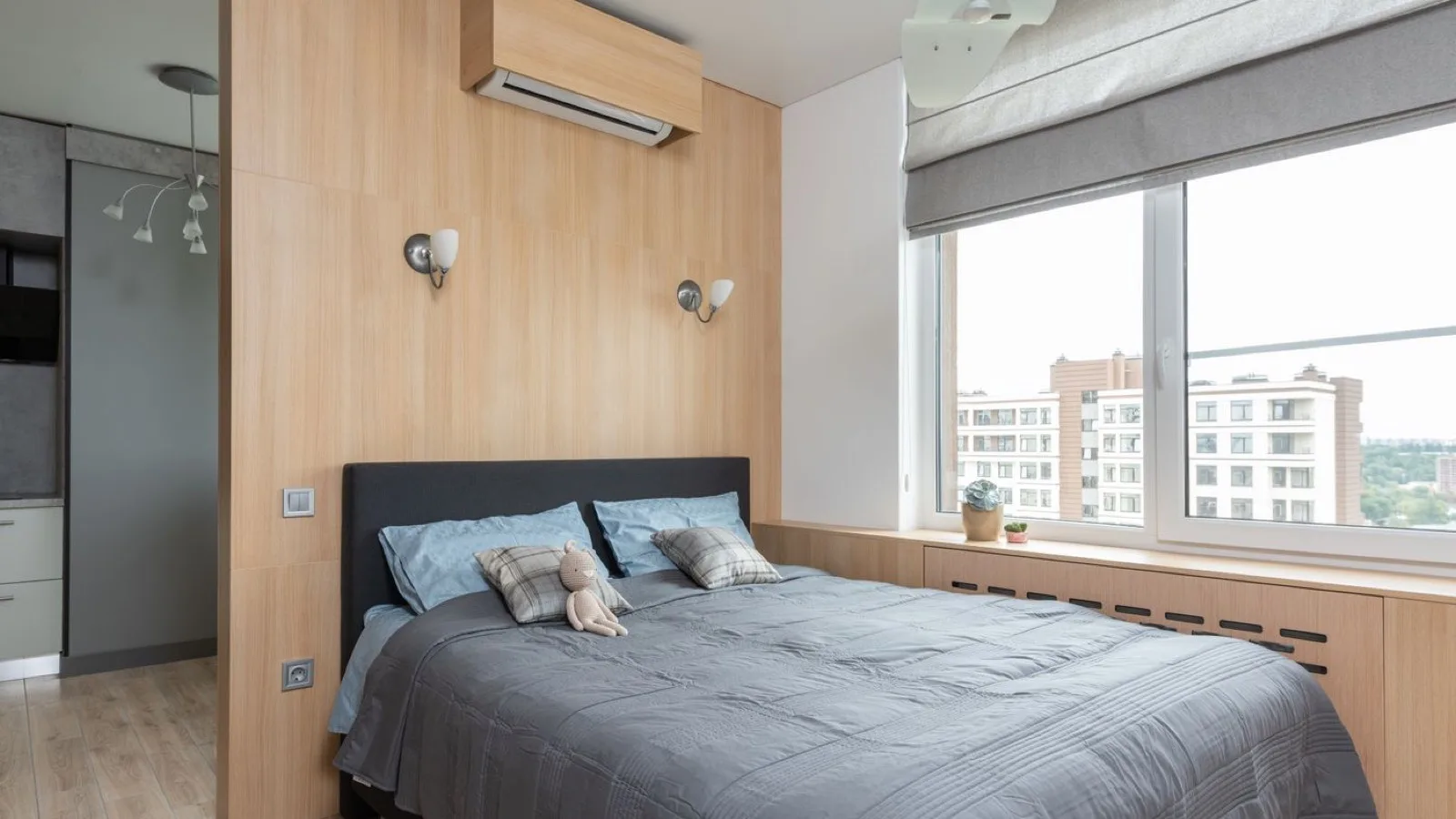
  • A good fit for bedrooms, home offices, garages, studios and ADUs up to roughly 600 sq ft
  • No 230V panel circuit, which is the expensive part of a mini split install in an older home or a condo
  • A pre-charged quick-connect line set, so no vacuum pump and no EPA Section 608 certification for the homeowner

The rest of this comparison gets into the specs, the efficiency numbers at each voltage, sizing and cold-weather limits.

What "115V Mini Split That Plugs Into a 120V Outlet" Really Means

In North America, "115V", "120V" and "110V" all describe the same standard single-phase household branch circuit; the numbers are legacy nominal voltages. Manufacturers use them interchangeably, and so do shoppers. What actually varies is how power gets from the breaker to the condenser.

  • Hard-wired. A dedicated breaker feeds permanent wiring — conduit or a whip — to the outdoor unit's terminal block. This is how MRCOOL's DIY 9K and 12K 115V systems are designed to be installed, and it is Zone Air's default too.
  • Cord and plug. A factory cord kit lands on the same outdoor terminal block, with a NEMA 5-15P plug on the other end for a grounded receptacle. Zone Air sells one as an accessory for its 115V systems.
  • Neither is "just plug it in anywhere." The circuit still has to be dedicated. Sharing it with a freezer, a shop vac or exterior lights invites nuisance trips and voltage sag on compressor start.
  • Local code decides. Some jurisdictions accept a cord-and-plug connection to outdoor HVAC equipment; some require permanent wiring and a disconnecting means regardless. That is a permit-office question, not a manufacturer question.

One more detail worth knowing: on both brands' 115V systems, the electrical connection is made outdoors at the condenser, and the indoor head is powered from the outdoor unit through the interconnecting cable. Nobody is plugging the wall head into a bedroom outlet.

Pioneer, Senville and Perfect Aire also sell 115V models, and a handful of smaller brands offer cord-connected units. Zone Air is not the only 115V ductless system on the market — it is the DIY quick-connect brand that sells a first-party cord kit to go with one. If a plug is the deciding feature, confirm the specific SKU rather than the brand.

Zone Air 115V: Key Specs (2026)

Zone Air's 115V line is two single-zone wall mounts, both DIY pre-charged with R-454B:

Spec9,000 BTU 115V12,000 BTU 115V
Coverage250–450 sq ft350–600 sq ft
Efficiency23 SEER223 SEER2
HeatingHSPF2 10.0 (Region IV), COP2 2.1 at 5°FHSPF2 10.0 (Region IV), COP2 2.1 at 5°F
Operating rangeHeating to −13°F; cooling to 131°FHeating to −13°F; cooling to 131°F
PowerDedicated 15A circuit, 15A single-pole breakerDedicated 15A circuit, 15A single-pole breaker
Indoor sound30 dB(A) quiet mode / 46 dB(A) turbo30 dB(A) quiet mode / 46 dB(A) turbo
RefrigerantR-454B, pre-charged line set included (16 ft)R-454B, pre-charged line set included (16 ft)
List price$1,899.99$1,999.99

Other points that matter for a DIY buyer:

  • The cord kit is an accessory, not a default. A 6 ft 12 AWG SJTW pigtail rated 15A at 125V with a NEMA 5-15P plug, ordered separately. Zone Air's own instructions are explicit: dedicated GFCI outlet, weatherproof in-use cover, never an extension cord, and only where local code allows.
  • Custom line set lengths. 16 ft comes in the box; Zone Air cuts single continuous runs from 5 to 75 ft, so a long run does not mean coupling two sets together.
  • Variable-speed inverter with a wide modulation range — the 9K modulates roughly 2,500–12,500 BTU/h in cooling, which is what keeps a small room stable instead of cycling.
  • Warranty of 5 years parts and 7 years compressor, valid on homeowner installation of the DIY SKUs, with 30-day returns on uninstalled systems.
  • Certifications include ENERGY STAR and NEEP listing, which is what most utility rebate programs key off now that the federal 25C credit has ended.

Note the efficiency figure carefully: 24 SEER2 is the 230V version of these same models. On 115V both are 23 SEER2. Marketing copy across the industry blurs this constantly.

MRCOOL DIY 115V vs a Cord-Connected System

MRCOOL DIY is the most widely stocked DIY mini split brand in 2026, with the 5th Gen line spanning 9K, 12K, 18K, 24K and 36K single-zone units plus multi-zone configurations. It shares the feature that matters most — a pre-charged quick-connect line set — so the refrigerant side of an MRCOOL install is every bit as DIY as Zone Air's.

  • 115V models. The standard DIY 9K and 12K single-zone systems are 115V, 60 Hz, single phase, and hardwired. MRCOOL specifies a dedicated circuit and an outdoor disconnect; a 20A, 120V dedicated circuit is the common recommendation, and where a receptacle is used it should be a NEMA 5-20R on its own circuit. Do not connect a 115V mini split to a general-purpose indoor receptacle shared with other loads.
  • Efficiency. The DIY 5th Gen 12K 115V is rated 23.5 SEER2 with 12.5 EER2 and HSPF2 10.2 — slightly higher than Zone Air's 23 SEER2 on 115V. Zone Air's efficiency advantage shows up at 230V (24 SEER2), not at 115V. Anyone telling you otherwise is comparing a Zone Air 230V number against an MRCOOL 115V one.
  • Warranty. The DIY 5th Gen line carries 5 years parts and 7 years compressor with no registration required, and MRCOOL's warranty terms require MRCOOL-supplied pre-charged line sets. The cheaper DIY Select tier is only 1 year parts and 2 years compressor — check which tier a listing is actually selling.
  • Line set lengths. Fixed sets in 16, 25, 35 and 50 ft. MRCOOL's manual supports coiling excess line horizontally behind the condenser with a minimum 4-inch bend radius, so surplus length is a tidiness issue rather than a fault — but a run that falls between sizes still means buying long and coiling.
  • Bigger units are 230V. The 18K, 24K and 36K DIY systems are 208/230V and hard-wired. There is no 115V DIY system above 12,000 BTU from any brand in 2026.

So the honest framing of the MRCOOL vs Zone Air choice on 115V is not efficiency and not refrigerant handling — those are close to a wash. It is the electrical connection. If you have, or can easily get, a dedicated circuit at the condenser location, MRCOOL is a strong pick and is easier to buy locally. If new panel work is the obstacle — a rental you cannot modify, a condo, a full panel, a detached studio with one existing outdoor receptacle — the cord-kit path is the reason to look at Zone Air. For a broader head-to-head, see our MRCOOL DIY vs Zone Air comparison and MRCOOL DIY vs competitors.

Room Size and BTU Guide for 115V DIY Mini Splits

Sizing matters more on small systems than people expect. Oversize and the unit short-cycles, never runs long enough to dehumidify, and swings the room temperature. Undersize and it runs flat out on the worst days and still loses ground.

CapacityTypical coverageVoltageTypical room
9,000 BTU250–450 sq ft115V or 230VBedroom, nursery, small home office
12,000 BTU350–600 sq ft115V or 230VPrimary bedroom, studio, small ADU
18,000 BTU600–800 sq ft208/230V onlyOpen living area, large garage
24,000 BTU750–1,000 sq ft208/230V onlyGreat room, shop, open-plan main floor

Adjustment factors: step up a size for vaulted ceilings, heavy west-facing glass, a poorly insulated garage or a hot-humid climate zone. A tight, shaded, well-insulated room can be sized at the lower end of the range, which usually improves dehumidification because the compressor runs longer at lower speed. Our free mini split sizing calculator does the arithmetic for your specific room, and the 9K for 250 sq ft and 12K for 500 sq ft comparisons go deeper on those two common cases.

One constraint to plan around: multi-zone DIY systems are all 208/230V. If you want two or three heads on one condenser, the 115V question is moot and you are budgeting for a double-pole circuit either way. MRCOOL's largest DIY multi-zone configuration is a six-zone system its catalogue rates up to about 2,290 sq ft total; that is the top of the range, not what a typical two- or three-zone kit covers.

Pre-Charged Line Sets: What Makes Any of This DIY

The plug is a convenience feature. The pre-charged line set is what actually removes the licensed technician from the job.

  • Pre-charged line set. The copper pair ships evacuated, filled with a measured charge of R-454B and sealed with mechanical valves at both ends. You route it and torque the quick-connect couplings; the valves open against each other and the circuit is complete. No vacuum pump, no manifold gauges, no refrigerant released — which is exactly why no EPA certification applies to the homeowner's step.
  • Communication cable. A multi-conductor cable carries power and control signals between the outdoor unit and the indoor head. Zone Air ships a labelled, pre-terminated cable with its DIY kits.
  • Length planning. Zone Air cuts single runs from 5 to 75 ft with 16 ft included; MRCOOL sells 16, 25, 35 and 50 ft fixed sets. Measure head-to-condenser and add a few feet for routing before you order, because changing your mind later means either coiling surplus or buying a second set.
  • Time on the tools. A straightforward single-zone install is a few hours of mechanical work for a competent DIYer, plus whatever the electrical takes.

Both brands share this design, so on the refrigerant side there is nothing to choose between them. Our easiest DIY install guide walks the sequence step by step.

Installation: Cord-Connected 115V vs Hard-Wired 230V

115V with a cord kit (Zone Air, where code allows)

  1. Mount the indoor head's bracket and drill a single 2.5–3 inch wall penetration, sloped toward the outside, for the line set, drain and cable
  2. Set the outdoor unit on a level pad or wall brackets with the clearances in the manual
  3. Pull the pre-charged line set through, torque the quick-connect fittings to spec with two wrenches, and land the communication cable
  4. Run the condensate drain with continuous fall to an approved termination
  5. Fit the cord kit to the outdoor terminal block and plug into the dedicated 15A GFCI receptacle with a weatherproof in-use cover, then run the start-up procedure

Hard-wired 115V or 208/230V (MRCOOL DIY and most others)

  1. Same mounting, line set and drain work
  2. Add a breaker at the panel — single-pole for 115V, double-pole for 208/230V — and run cable or conduit to the equipment location
  3. Install an outdoor disconnect within sight of the condenser, in a rainproof enclosure, and a whip from the disconnect to the terminal block
  4. Terminate per the wiring diagram in the manual, then start up
Be realistic about the electrician. Even the cord-kit route needs a dedicated 15A circuit terminating in a GFCI receptacle outside. If your condenser location already has one, you may genuinely avoid any new electrical work. If it does not, you are paying an electrician for a new circuit either way — you are just paying for a 15A 120V circuit instead of a 230V one, which is the cheaper of the two. If you are unsure about any of it, hire it out; electrical work is the part of a DIY mini split that actually hurts when it goes wrong.

Cold-Climate Performance: When 115V Is Enough

Heat pump output falls as the outdoor temperature drops, so the honest question is not "does it work in winter" but "does it still cover the room's heat loss on your design day".

  • Zone Air 115V wall mounts are rated to heat down to −13°F, with a published COP2 of 2.1 at 5°F. Real output, materially reduced at the bottom of the range.
  • MRCOOL standard DIY units are also rated to −13°F in heating per the 5th Gen manual's operating range.
  • MRCOOL DIY Hyper Heat (12K and 18K) extends to −22°F and is the pick if the mini split is the primary heat source in a genuinely cold climate — but it is 208/230V and hard-wired, so it is outside the 115V conversation entirely.

A 115V system is a strong fit where it supplements existing heat: a bedroom over a garage, a finished basement, a bonus room, an addition the furnace never reached, a detached office or studio. It is the wrong tool for whole-house heating in a cold zone. Our cold-weather guide covers capacity derating in detail, and the cold-climate rankings cover the systems built for it.

Which 115V DIY Mini Split Should You Choose in 2026?

The decision comes down to your panel, not your climate zone.

  • No spare capacity, no permission, or an existing outdoor receptacle: Zone Air's 9K or 12K 115V with the optional cord kit is the path of least resistance, provided your jurisdiction allows a cord-and-plug connection to outdoor equipment. Confirm that before you order the kit.
  • You can run a new circuit anyway: MRCOOL DIY's 115V 9K or 12K is an excellent system, slightly more efficient than Zone Air at this voltage (23.5 vs 23 SEER2 on the 12K), and much easier to buy and return locally. The cord is not worth paying a premium for if you are calling an electrician regardless.
  • Bigger space or multi-zone: step up to 208/230V. Zone Air's 230V single zones are 24 SEER2, MRCOOL's larger DIY units cover up to 36K single zone, and multi-zone is 230V across the board. You lose the plug, you gain capacity and efficiency.
  • Cold climate, mini split as primary heat: MRCOOL DIY Hyper Heat at −22°F, hard-wired, or a professionally designed multi-zone system.

Whichever way you go, do three things before ordering: measure the room and run it through the sizing calculator, look at what is actually available at the condenser location electrically, and measure the line run from head to pad so you order the right length the first time. Those three decisions determine whether this is a weekend project or a series of extra trips to the supply house.

FAQ

115V Plug-In Mini Split FAQs

Not into a regular shared outlet. A 115V mini split draws enough current that it needs its own dedicated 15A circuit, and where a cord-and-plug connection is used it should land on a dedicated GFCI receptacle with a weatherproof in-use cover, located outdoors at the condenser. Never run one on an extension cord or share the circuit with other loads. Some jurisdictions do not permit a cord-and-plug connection at all, so check local code first.
No — Zone Air's 115V systems are hard-wired by default. The company sells an optional 6 ft, 12 AWG cord kit with a standard NEMA 5-15P three-prong plug that lands on the outdoor unit's terminal block and converts the install to a plug-in connection where local code allows it. It is ordered separately, and the indoor head is never the thing plugged in.
MRCOOL's DIY 9K and 12K single-zone systems run on 115V, but they are designed as hard-wired installs on a dedicated circuit with an outdoor disconnect. MRCOOL does not sell them as cord-and-plug systems. The larger 18K, 24K and 36K DIY units are 208/230V and hard-wired only.
Usually slightly, yes, on the same model line. Zone Air's 9K and 12K wall mounts are 23 SEER2 on 115V and 24 SEER2 on 230V. MRCOOL's DIY 5th Gen 12K 115V is rated 23.5 SEER2. The gap is small enough that convenience and installation cost normally matter more, but do compare at the voltage you will actually install.
A 9,000 BTU 115V system suits roughly 250 to 450 sq ft — a bedroom, nursery or home office. A 12,000 BTU 115V system suits roughly 350 to 600 sq ft — a primary bedroom, studio or small ADU. Above that you move to 18,000 BTU and up, which are 208/230V and hard-wired across every DIY brand. Adjust up for vaulted ceilings, heavy west-facing glass or poor insulation.
Yes, with reduced capacity as it gets colder. Zone Air's 115V wall mounts are rated to heat down to −13°F with a published COP2 of 2.1 at 5°F, and MRCOOL's standard DIY units are rated to −13°F as well. If you need a heat pump as the sole heat source in a genuinely cold climate, look at MRCOOL's DIY Hyper Heat (12K and 18K, −22°F) — but those are 208/230V and hard-wired.
Usually for the circuit, not for the system. Both brands' 115V units need a dedicated 15A or 20A circuit at the condenser that most homes do not already have outside. If a suitable dedicated outdoor receptacle already exists, a cord kit can let you skip new panel work entirely. What you never need on a pre-charged system is an EPA-certified technician for the refrigerant side.
No. Both Zone Air and MRCOOL DIY ship pre-charged line sets with quick-connect fittings, so the refrigerant circuit is sealed at the factory and you never open it. That is also why no EPA Section 608 certification is required for a homeowner install of these systems.
Specs, prices and warranty terms cited here are the manufacturers' published figures as of September 2026, are subject to change, and should be verified on the manufacturer's site before purchase. Electrical requirements vary by jurisdiction; this article is general information, not a substitute for your unit's installation manual, the National Electrical Code as adopted locally, or a licensed electrician. Ductless4Less is not affiliated with or endorsed by MRCOOL or Zone Air; brand names are trademarks of their respective owners.
Sources & Methodology

Where our data comes from

Capacity, efficiency, electrical and warranty figures are the manufacturers' published specifications; prices are list prices checked in September 2026; coverage ranges are the manufacturers' own recommended room sizes.

Keep Reading

Related comparisons

Size the room, check the legal side of a self-install, or compare the two DIY brands head to head.

Avery Lang

Lead Reviewer, Ductless4Less

Avery leads a small team of hands-on DIY installers who cross-check every SEER2, warranty, and price claim against AHRI-certified and manufacturer documentation. The goal is simple: help homeowners buy and install the right ductless mini split for the best possible value, without the salesy noise.

Find the right size before you worry about the plug

Run your room through the free calculator, then compare single-zone systems by capacity.