
Ductless mini splits for less · 2026 buyer's guides & free sizing helpSize my system →

Quick Answer: Do You Need EPA 608 Certification to Install a DIY R-32 Mini Split in 2026?

No. Homeowners do not need EPA Section 608 certification to install a true DIY mini split that ships with a sealed, pre-charged line set and quick-connect couplings. Systems built this way — Zone Air, MRCOOL DIY and the other quick-connect lines — arrive with the refrigerant already sealed inside the line set and the units. Because you never open the refrigerant circuit, you are not performing any of the activities Section 608 regulates, and no vacuum pump or manifold gauge set is required.

You absolutely do need EPA 608 certification to install or service a conventional mini split from Mitsubishi, Daikin, Fujitsu, Pioneer or any other brand that ships the charge in the outdoor unit with empty copper line sets. Those installs require flaring copper, pressure testing with nitrogen, pulling a deep vacuum with a pump and micron gauge, and then releasing the charge. Every one of those steps opens the appliance, and opening the appliance is precisely what triggers the certification requirement. Self-installing does not exempt you from it.

Two things apply to everybody, certified or not. Intentionally venting refrigerant — including R-32 and R-454B — is illegal regardless of who you are or how small the system is. And since January 1, 2025 you cannot legally buy refrigerant in containers larger than 2 pounds without a certification, which means a homeowner can lawfully install a sealed system and still have no lawful way to recharge it. Plan on a certified technician for any leak.

The practical takeaway when shopping: if the manual says the line set is pre-charged and no vacuum is required, you are clear under federal refrigerant law. If it does not say that, budget for a licensed installer. The rest of this guide explains why, and what else changed in 2026.

How EPA Section 608 Works in 2026 (and What "EPA Certification" Really Means)

Section 608 of the Clean Air Act is the core U.S. rule governing who may handle refrigerant in stationary air conditioning, refrigeration and heat pump equipment. It has been in force since the early 1990s. Its fundamentals have not changed, but the substances it covers have expanded from ozone-depleting chemicals to high-GWP HFCs and now to the A2L replacements.

Here is what the program actually regulates:

  • Opening the refrigerant circuit. Certification is required to open an appliance for maintenance, service or repair in a way that could release refrigerant — attaching or detaching hoses and gauges, adding refrigerant, or removing it.
  • Recovery, recycling and reclamation. Technicians must use approved recovery equipment and evacuate systems to specified levels before opening or disposing of them. Venting any covered refrigerant is prohibited.
  • The sales restriction. Refrigerant in containers larger than 2 pounds may only be sold to certified technicians or to employers who can show they employ one. Since January 1, 2025 that restriction covers HFCs and their substitutes, not just ozone-depleting refrigerants.
  • Four certification types. Type I covers small appliances, Type II covers high-pressure equipment including most comfort cooling, Type III covers low-pressure equipment, and Universal covers all three. Each requires passing a proctored exam through an EPA-approved certifying organization.
  • No expiration. Section 608 technician certification is permanent. There is no renewal requirement and no continuing-education clock.
  • Apprentices. An uncertified apprentice may work on refrigerant circuits only under the direct supervision of a certified technician.

The critical point for homeowners is the trigger. Connecting a factory-sealed quick-connect line set is not opening the appliance: no hose is attached, no refrigerant is added, and none is removed or vented. The mechanical valves inside the coupling open against each other as you torque the nut. Section 608 simply does not reach that act.

Federal law is not the only law. Section 608 governs refrigerant, not permits. Mechanical and electrical permitting, inspection and contractor licensing are set by your state, county or city, and several jurisdictions require a permit or a licensed contractor for the work regardless of what the refrigerant rules say. Confirm locally before you buy.

2026 EPA Refrigerant Regulations: the R-410A Phase-Out and the 700 GWP Limit

The regulatory picture shifted hard between 2024 and 2026, and then partly shifted back. Here is the timeline that actually matters:

  • January 1, 2025. EPA's Technology Transitions Rule under the AIM Act prohibited manufacturing or importing new residential and light commercial HVAC equipment using refrigerants above 700 GWP. R-410A, at roughly 2,088 GWP, was out for new production.
  • January 1, 2026 — then reversed. The original rule also set a deadline to stop installing that equipment. On May 21, 2026 EPA finalized a reconsideration that removed the installation deadline for residential and light commercial systems: R-410A equipment manufactured or imported before January 1, 2025 may be installed until existing stock is exhausted. New York State's Part 494 is the notable exception and keeps a 2026 deadline in force.
  • January 1, 2026 and 2027 — VRF. Variable refrigerant flow systems above 700 GWP can no longer be manufactured or imported as of January 1, 2026, and can no longer be installed as of January 1, 2027, with an extension to January 1, 2028 for projects permitted before October 5, 2023.
  • Through 2036. The AIM Act steps HFC production and imports down to 15% of baseline, which is the long-run force pushing the industry toward A2L and natural refrigerants no matter what any individual deadline says.

So the honest 2026 answer to "can I still install R-410A?" is: in most states, yes, from pre-2025 stock, while it lasts. But nobody is making it anymore, the phasedown is squeezing supply, and a system you buy today will need servicing with a refrigerant whose price is trending the wrong way. R-32 and R-454B both sit comfortably under the 700 GWP ceiling and are what new equipment ships with.

R-32 vs R-454B vs R-410A: What DIY Mini Split Owners Need to Know

Three refrigerant names show up on 2026 spec sheets. Here is what separates them in practical terms.

RefrigerantGWPSafety classStatus in new residential equipment
R-410A~2,088A1 (non-flammable)No longer manufactured or imported for new residential systems; pre-2025 stock may still be installed in most states
R-454B~466A2L (mildly flammable)The most common A2L in pre-charged DIY mini splits; similar operating pressures to R-410A
R-32~675A2L (mildly flammable)Used by several manufacturers in high-efficiency splits; slightly higher operating pressures

Both R-32 and R-454B replace R-410A for the same reason: they fall under the 700 GWP ceiling the AIM Act's Technology Transitions rule imposes. Both are classified A2L, which means mildly flammable — a lower flammability limit, a slow burn velocity and a low heat of combustion compared with genuinely flammable gases like propane. Equipment certified to UL 60335-2-40 addresses those characteristics with charge limits per room volume and, on many models, a refrigerant detection system that runs the indoor blower if it senses a leak.

For a DIY buyer, the refrigerant type is much less important than it sounds. All of that engineering happens at the factory. On a sealed pre-charged system the refrigerant never touches your hands, and the practical decisions come down to brand, efficiency, line set options and warranty terms. Zone Air's DIY lineup uses R-454B; MRCOOL's DIY 5th Gen line does too.

EPA Leak Repair Rules, Leak Rate, and Why They Rarely Touch a Home Mini Split

"Leak rate" is the percentage of a system's full charge lost over a rolling 12-month period. Exceed the threshold for your equipment category and repair obligations kick in:

  • 10% for comfort cooling appliances
  • 20% for commercial refrigeration
  • 30% for industrial process refrigeration

When a system exceeds its threshold, leaks must be repaired within 30 days of discovery — or the owner must develop a retrofit or retirement plan within 30 days and complete it within a year — with verification testing afterward.

Two charge thresholds decide whether any of this applies to you:

  • The long-standing Section 608 leak repair program covers appliances with a full charge of 50 pounds or more of ozone-depleting refrigerant.
  • EPA's Emissions Reduction and Reclamation rule extended leak repair to HFCs and certain HFC substitutes at 15 pounds or more, effective January 1, 2026 — but it includes an explicit exemption for the residential and light commercial air conditioning and heat pump subsector.

A single-zone DIY mini split carries roughly 2 to 6 pounds of refrigerant. It is below both thresholds on charge size, and residential heat pumps are carved out of the newer rule anyway. You will never face quarterly leak inspections or EPA reporting on a home system.

What does still apply, universally, is the venting prohibition. Releasing refrigerant to the atmosphere is illegal at any charge size, for anyone. Clean Air Act civil penalties are adjusted for inflation annually and currently run into the tens of thousands of dollars per violation per day. If you suspect a leak — oily residue at a fitting, ice on the line, repeated error codes, weak output — shut the system down and call a certified technician. Do not try to top it off.

Mini Split Categories in 2026: Traditional vs DIY Pre-Charged

Not every mini split advertised as "easy install" is a DIY product. The dividing line is where the refrigerant lives when the box arrives.

Traditional mini splitTrue DIY pre-charged
BrandsMitsubishi, Daikin, Fujitsu, LG, most Pioneer and Senville modelsZone Air, MRCOOL DIY, Perfect Aire Quick Connect, Klimaire DIY
Where the charge shipsOutdoor unit only; line sets are empty copperSealed in the line set and both units
Line set workCut, deburr, flare, torque, nitrogen pressure testRoute it and torque two quick-connect couplings
VacuumDeep vacuum to roughly 500 microns with a pump and micron gaugeNone — done at the factory
ChargingOpen service valves, weigh in additional charge for long runsNone
EPA 608 required?Yes — the circuit is openedNo — the circuit is never opened

A homeowner may perform the non-refrigerant work on either type — mounting brackets, drilling the wall penetration, hanging the head, setting the condenser, routing the drain. What separates the categories is the last 20 minutes of the job. On a traditional system that 20 minutes is regulated work. On a pre-charged system it is two torque-wrench pulls. Our easiest DIY mini split install guide walks through what that actually looks like on the day.

What "Pre-Charged Line Set" Really Means (and How Quick-Connects Work)

The phrase gets used loosely in listings, so it is worth being precise. On a genuine DIY system:

  • The line set itself is charged. The suction and liquid lines are evacuated at the factory to pull out air and moisture, filled with a measured charge of R-454B or R-32, and sealed with mechanical valves at both ends. That is why no vacuum pump appears in the tool list.
  • Quick-connect fittings hold the valves shut in transit. When you thread the coupling and torque it to the manufacturer's spec, the internal valves open against each other and the circuit becomes continuous. No hoses, no gauges, nothing vented.
  • The factory did the regulated work. Evacuation, the nitrogen pressure test and the charge calculation all happened at an authorized facility before the box shipped. That is the entire legal basis for the DIY category.

Watch for the imitation. A "pre-charged condenser" means only the outdoor unit holds refrigerant; the field-installed line set is empty copper and still needs flaring, vacuuming and charging by a certified technician. If a product page does not explicitly say the line set ships pre-charged with quick-connect fittings, assume it does not. Our breakdown of pre-charged line set rules and warranty terms covers the traps in more detail, and the pre-charged brand comparison lists who actually sells them.

What You Can Legally Do Without EPA 608 — and What You Cannot

On a sealed pre-charged system, the whole install is within reach of a careful homeowner. Most take a single weekend; simple single-zone jobs run a few hours.

Steps any homeowner can do

  • Choose the indoor unit location and mark the mounting plate
  • Drill the wall penetration for the line set, drain and control cable, sloped slightly toward the outside
  • Mount the bracket and hang the air handler
  • Set the outdoor unit on a level pad or wall brackets with the clearances the manual specifies
  • Route the insulated pre-charged line through the penetration with gentle bends
  • Connect the quick-connect fittings: remove the shipping caps, hand-thread, then torque to spec with two wrenches until the factory valves open
  • Land the control cable on matching terminals at both ends
  • Run the condensate drain with continuous fall to an approved termination
  • Energise the system and run the start-up procedure

Steps reserved for an EPA-certified technician

  • Cutting, flaring or brazing refrigerant lines
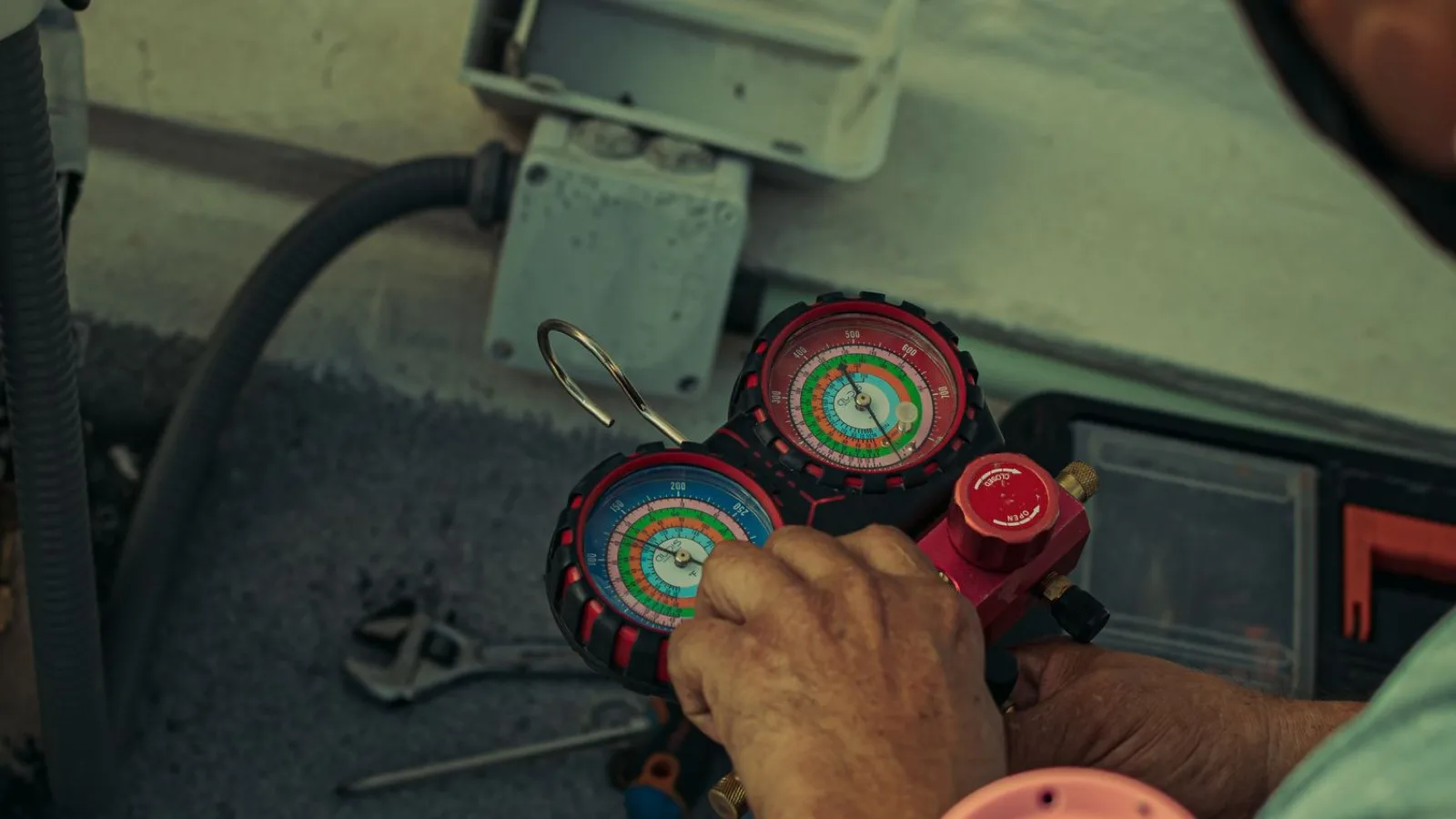
  • Attaching or detaching manifold gauges and hoses from service ports
  • Pulling a vacuum or using a micron gauge on the circuit
  • Adding refrigerant, recovering refrigerant, or replacing a compressor
  • Any repair that opens the sealed refrigerant circuit

The electrical side sits in its own lane. On a 208–230V system an electrician typically runs the dedicated double-pole circuit and the outdoor disconnect; that is electrical licensing, not EPA certification. Some 115V systems can be powered through a cord kit into a dedicated GFCI outlet where local code allows it, which removes the panel work from a straightforward install — see our comparison of 115V plug-in DIY mini splits for where that actually holds up.

When You Still Need a Certified Technician

A pre-charged install is straightforward, but ownership has moments that are not:

  • Suspected leak. Weak heating or cooling, oily residue at a fitting, ice forming on the line set or repeated error codes all point at refrigerant loss. Leak detection and repair are certified work, and you cannot legally buy refrigerant to recharge it yourself.
  • Anything involving gauges or recovery. Manifold sets, recovery machines, adding R-32 or R-454B, replacing a compressor or a coil — all Section 608 activities, without exception.
  • Modifying the line set. Cutting and re-flaring a pre-charged line, extending past the factory length, or converting a system to a different refrigerant are not DIY tasks. They void warranties and can violate the venting prohibition.
  • End of life. Refrigerant must be recovered before an appliance is disposed of. Do not send an old system to a scrapyard with the charge still in it.

Technicians are required to give the equipment owner service records documenting refrigerant added or recovered. Formal recordkeeping obligations attach to larger equipment, but ask for the paperwork on a residential job too — it is useful evidence if a warranty claim ever turns on how the system was serviced.

Splitting the job is completely normal and often the smartest route: do the mechanical work yourself, hire out the 230V circuit, and keep a certified technician's number for anything that touches refrigerant.

Section 608 Exam Topics That Matter to Mini Split Owners

You do not need to sit the exam to install a pre-charged system, but knowing what it covers explains why traditional installs are left to professionals.

  • Leak rate calculations and thresholds — 10% comfort cooling, 20% commercial refrigeration, 30% industrial process refrigeration, and the 30-day repair clock once a threshold is exceeded.
  • The venting prohibition, and the difference between recovery, recycling and reclamation — including which one is required before refrigerant can change hands.
  • Evacuation levels for different appliance sizes, and the recovery equipment certified for each.
  • Recordkeeping — what must be documented, and what the technician owes the equipment owner.
  • Safety — pressure hazards, cylinder handling, and now A2L-specific practice.

The DIY pre-charged category exists precisely because manufacturers moved all of that work into the factory. It is not a loophole; it is a different product design that removes the regulated step from the job site.

Safety and Building Code with A2L Mini Splits (R-32 and R-454B)

"Mildly flammable" sounds alarming and reflects a carefully bounded risk. A2Ls have a low burning velocity, a high minimum ignition energy and limited heat release compared with truly flammable refrigerants. R-32 has been the default in Japan, Australia and much of Europe for years, with a solid field record.

  • Equipment using R-32 or R-454B is certified to UL 60335-2-40, which sets maximum charge per room volume, mitigation requirements, and restrictions near ignition sources. Many A2L systems include a refrigerant detection system that trips at a fraction of the lower flammability limit and runs the indoor blower to disperse a leak.
  • Factory-engineered pre-charged systems are designed and tested against those limits, so the homeowner is not doing charge-per-volume math — but you should still respect the minimum room area in the manual, which is why manufacturers publish one.
  • Local codes may add requirements beyond the federal picture: permits, disconnects, clearances, and in some jurisdictions specific provisions for A2L equipment. Check before you drill.
  • Follow the manufacturer's clearance table for both units — distance to ceilings, walls, electrical panels, windows and any open-flame appliance.

None of this changes who may handle the refrigerant. A2L rules are equipment and installation standards, not licensing rules.

Cost, Efficiency and Warranty: Why Pre-Charged Usually Wins

For most single-zone and moderate multi-zone projects, the numbers favour a DIY pre-charged system — and the refrigerant rules are part of why.

  • Labor is the big line item. A professionally installed 12,000 BTU mini split commonly lands in the $3,000–$6,000 range all-in, with labor typically $1,700–$3,700 of that depending on market and complexity. Doing the mechanical work yourself on a pre-charged system removes most of it. Our installation cost guide breaks down the worked examples.
  • No tools to rent or buy. A vacuum pump, micron gauge and manifold set is a few hundred dollars you simply do not spend — and you avoid paying a technician to make a single trip for the "vacuum and release charge" step.
  • Efficiency still varies. Pre-charged DIY systems run roughly 18 to 24 SEER2. Zone Air's 230V single-zone wall mounts are 24 SEER2 and its 115V versions 23 SEER2; MRCOOL's DIY 5th Gen 12K 115V is 23.5 SEER2. The spread between a 24 SEER2 system and an 18 SEER2 one is worth real money over 15 years, so do not treat "DIY" as one efficiency tier.
  • Warranties are written for it. Zone Air and MRCOOL's DIY 5th Gen line both carry 5-year parts and 7-year compressor coverage that survives homeowner installation of their DIY SKUs, with no registration required on MRCOOL's 5th Gen; MRCOOL's lower-cost DIY Select tier is 1-year parts and 2-year compressor. Traditional manufacturers frequently require proof of licensed installation, and at least one budget brand voids coverage outright on a self-install. Read the warranty page before you read the spec sheet.
A note on tax credits. The federal 25C Energy Efficient Home Improvement Credit ended for property placed in service after December 31, 2025. Utility and state rebates still exist in many areas and often key off ENERGY STAR or NEEP listings, so check your utility rather than assuming a federal credit.

2026 Buying Checklist: Staying on the Right Side of Section 608

  1. Confirm it is truly DIY. Look for sealed quick-connect line sets and explicit "no vacuum required" language. A pre-charged condenser alone is not enough.
  2. Check the refrigerant. Verify R-454B or R-32 at or below 700 GWP. Buying leftover R-410A equipment is still legal in most states but leaves you on a shrinking service supply.
  3. Compare SEER2 honestly at your voltage. The same model often rates differently on 115V and 230V. Aim for 22+ SEER2 if the budget allows, and compare like for like.
  4. Get the line set length right at the time of order. Measure indoor head to outdoor pad, add for routing around corners, and buy one continuous run rather than joining two. Zone Air cuts single runs from 5 to 75 feet; MRCOOL sells fixed 16, 25, 35 and 50 foot sets. Fewer couplings means fewer places a leak can start — and a leak on any pre-charged system means a service call, not a DIY fix.
  5. Match the power supply to your panel. 115V models need a dedicated 15A circuit at the condenser; a cord kit is optional on some and only where code allows. 208–230V models need a dedicated double-pole circuit and a disconnect — still an electrician's job, not an EPA one.
  6. Plan for expansion. If a second or third head is likely later, choose a condenser that supports the head types you will want. Our multi-zone rankings cover which platforms mix wall, cassette and ducted heads.
  7. Read the warranty for DIY language. Confirm homeowner installation is explicitly supported and check whether the manufacturer requires its own line sets.
  8. Check local permitting before you order, not after the pallet arrives.

Get those eight right and the refrigerant rules stop being an obstacle. Size the room first with the free mini split sizing calculator, then pick the system that matches your power supply and line run.

FAQ

EPA Certification and DIY Mini Split FAQs

No, not for a true DIY system whose line set ships sealed and pre-charged with quick-connect fittings. Section 608 technician certification is triggered by opening the refrigerant circuit — attaching hoses, adding refrigerant, recovering refrigerant. Torquing a factory-sealed quick-connect coupling does none of that. You do need certification to install a conventional mini split whose field-cut copper line set has to be flared, vacuumed and charged.
Under federal EPA rules, yes, when no refrigerant is released, added or recovered — which is the case on a sealed pre-charged system. Federal refrigerant law is not the only law that applies, though. Mechanical and electrical permits, inspection and licensing are set by your state, county or city, and some jurisdictions require a licensed contractor or an electrical permit for the circuit. Check locally before you start.
No. Section 608 covers ozone-depleting refrigerants, HFCs such as R-410A, and the A2L substitutes R-32 and R-454B under the same certification framework. What changed with A2Ls is the equipment safety standard — UL 60335-2-40 charge limits and refrigerant detection systems — not who is allowed to handle the refrigerant.
Generally no. Since January 1, 2025 the Section 608 sales restriction covers HFCs and their substitutes, and containers larger than 2 pounds may only be sold to certified technicians or their employers. That is the practical catch of DIY ownership: you may legally install a sealed pre-charged system, but you have no legal way to buy refrigerant to recharge it. A leak means calling a certified technician.
In most of the country, yes — with a caveat. EPA finalized a rule on May 21, 2026 that removed the January 1, 2026 installation deadline for residential and light commercial equipment above 700 GWP, so R-410A equipment manufactured or imported before January 1, 2025 can be installed until that stock runs out. New York's Part 494 keeps its own 2026 deadline in force. New equipment is no longer being manufactured with R-410A, so you are buying from a shrinking pool.
Almost never. The Section 608 leak repair program applies to appliances with a full charge of 50 pounds or more of ozone-depleting refrigerant, and the HFC leak repair requirements that took effect January 1, 2026 apply at 15 pounds or more — with an explicit exemption for the residential and light commercial air conditioning and heat pump subsector. A single-zone mini split carries roughly 2 to 6 pounds. The venting prohibition still applies to everyone, at any charge size.
A pre-charged condenser holds the system's refrigerant in the outdoor unit and ships with empty copper line sets you have to flare, vacuum and open to the charge. That is a certified-technician job. A pre-charged line set is itself evacuated, filled and sealed at the factory with mechanical valves at both ends, so the homeowner's step is purely mechanical. If a listing does not explicitly say the line set is pre-charged, assume it is not.
Exams are given by EPA-approved certifying organizations and typically cost somewhere in the tens of dollars per attempt depending on the provider and the type. There are four types: Type I for small appliances, Type II for high-pressure equipment including comfort cooling, Type III for low-pressure equipment, and Universal for all three. Certification does not expire and does not have to be renewed.
This guide is general information, not legal advice. Regulatory facts, specs, prices and warranty terms are current as of September 2026 and are subject to change; verify against the EPA and the manufacturer before you buy or install. State and local permitting, inspection and licensing rules apply independently of federal refrigerant law. Ductless4Less is not affiliated with or endorsed by MRCOOL, Zone Air, Mitsubishi, Daikin or Fujitsu; brand names are trademarks of their respective owners.
Sources & Methodology

Where our data comes from

Regulatory statements are taken from EPA rule text, EPA program pages and EPA fact sheets; equipment figures are the manufacturers' published specifications, checked in September 2026.

Keep Reading

Related guides

What a pre-charged line set changes on install day, what a professional install actually costs, and which brands sell true quick-connect systems.

Avery Lang

Lead Reviewer, Ductless4Less

Avery leads a small team of hands-on DIY installers who cross-check every SEER2, warranty, and price claim against AHRI-certified and manufacturer documentation. The goal is simple: help homeowners buy and install the right ductless mini split for the best possible value, without the salesy noise.

Pick a system you can legally install yourself

Size the room with the free calculator, then compare pre-charged quick-connect systems by zone count.