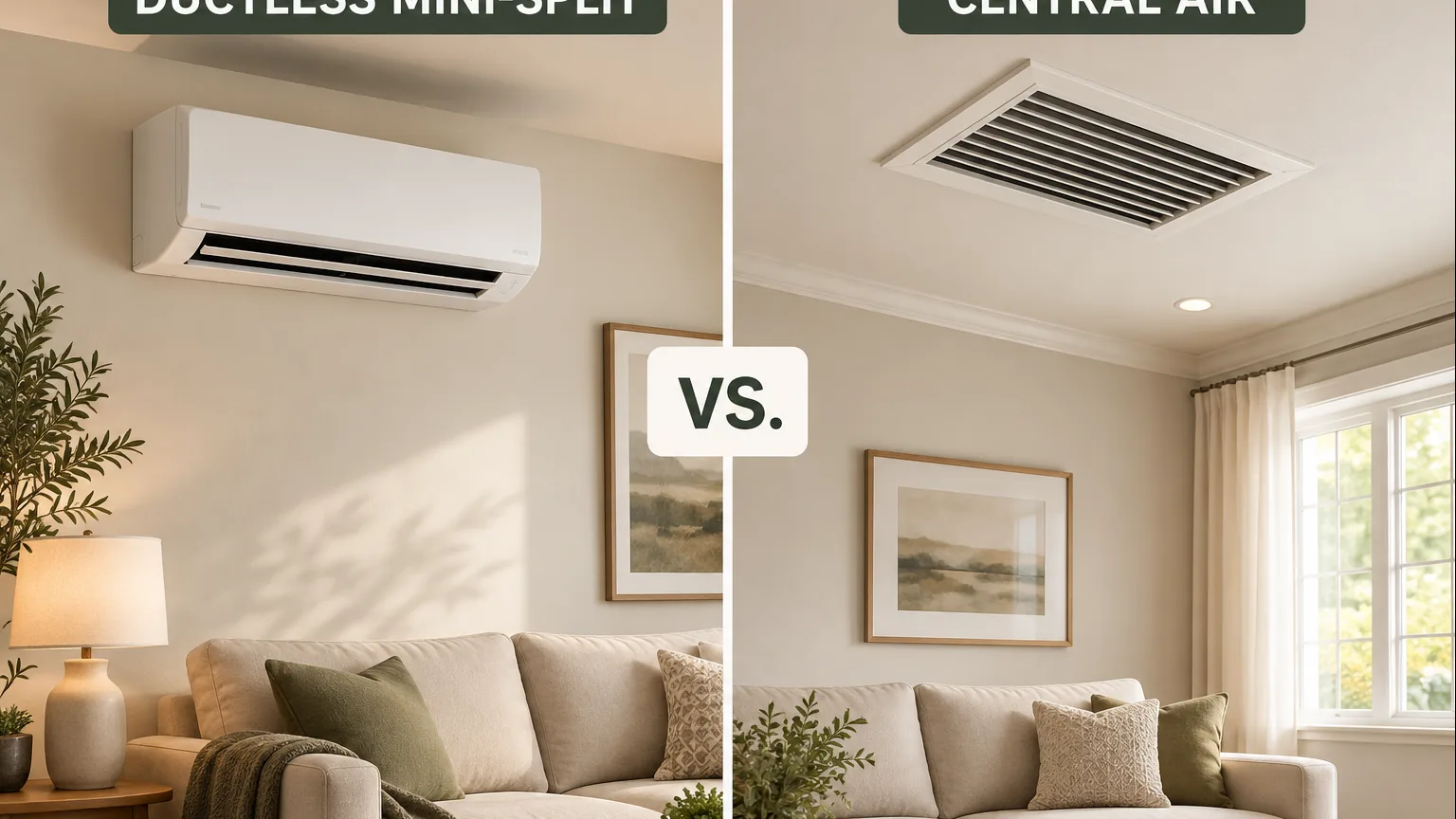
Cost: upfront and operating
Upfront, the answer hinges on ductwork. A single-zone mini split typically runs about $3,000 to $6,000 installed, while a whole-home multi-zone system with several indoor heads can reach $8,000 to $19,000 or more. Central air, by contrast, is often $4,000 to $8,000 to replace when your home already has sound, sealed ductwork — but if a technician has to design and route new ducts, that figure climbs to roughly $7,000 to $15,000-plus and the install gets far more disruptive.
Operating cost usually tilts toward mini splits. Their higher efficiency and lack of duct losses mean lower monthly bills, and because they are heat pumps, a single system handles both heating and cooling. Central air only cools; you still need a separate furnace or heat source. Over a 15-to-20-year life, the efficiency gap can offset a chunk of a mini split's higher upfront price in a duct-free home.
Tip: Installed prices swing 10–20% by region and by how much line-set length, electrical work, or duct repair your job needs. Always get two or three itemized local quotes rather than trusting a national average.
Efficiency and energy bills
Efficiency is the mini split's clearest advantage. Ductless systems reach SEER2 cooling ratings of roughly 16 to 33-plus, while central air conditioners generally land between SEER2 13.4 and about 21. The bigger difference is invisible: the U.S. Department of Energy notes that a central system can lose 20 to 30 percent of the air it conditions to leaks and heat transfer in the ducts, especially where ducts run through unconditioned attics or crawlspaces. A ductless head delivers conditioned air straight into the room, so none of that is wasted.
Inverter-driven compressors add to the gap. Instead of switching fully on and off like a conventional AC, a mini split ramps its output up and down to match the load, holding a steadier temperature and drawing less power at part load. That said, a modern, well-sealed central system with high-SEER2 equipment narrows the difference — verify the AHRI-certified SEER2 for the exact models you are weighing rather than relying on brochure figures.
Installation: ductwork is the deciding factor
This is where most decisions are actually made. A mini split needs only a small (about three-inch) hole through the wall for each indoor head's line set, so a single-zone system is frequently a one-day install with no demolition. That makes ductless the natural fit for older homes, additions, garages, finished basements, and any space that never had ducts. Central air, on the other hand, only makes economic sense when usable ductwork already exists; retrofitting ducts into a finished home means opening ceilings and walls, and it is both expensive and messy.
The flip side: mini splits require an indoor head in every zone you want to condition, plus a condensate drain and an electrical circuit per system. In a large home that means several wall units and line sets to route and seal. Central air keeps all of that hidden behind a single air handler and a network of ducts, which many homeowners prefer for a whole-house install where the ducts are already there.
Tip: If you are replacing an aging central system and the ductwork is leaky or undersized, price out ductless too — you may spend less overall than repairing ducts and gain efficiency and zoning in the bargain.
Zoning, aesthetics, noise, and lifespan
Zoning is a genuine mini split strength. Each indoor head has its own thermostat, so you can cool a busy living room while barely conditioning an empty guest bedroom — no fighting over one whole-house setpoint. Standard central air runs the entire house from a single thermostat unless you add motorized zone dampers, which raises cost and complexity.
Aesthetics cut the other way. Central air shows nothing but vents; mini split heads are visible on the wall or ceiling, which some homeowners dislike (recessed and ceiling-cassette units soften this). On noise, ductless generally wins indoors — wall heads run about 19 to 40 decibels, quieter than air rushing through registers — while both systems place a compressor outside with comparable sound. As for longevity, both typically last around 15 to 20 years with regular maintenance; a mini split's compressor is the life-limiting part, and clean filters and coils matter most for either system.
So which should you choose?
Choose a mini split if your home has no ductwork or leaky ductwork, you want the lowest energy bills, you value independent room-by-room control, or you are conditioning an addition, older home, or specific problem rooms. Choose central air if you already have good, sealed ductwork, you want uniform whole-home cooling with nothing visible on the walls, and a like-for-like replacement is the least-disruptive path. Many homes even use both — central air for the main floors and a mini split for a bonus room or garage the ducts never reached. When in doubt, get a Manual J load calculation and two or three local quotes for each option before deciding.